

Artículos recientes
10.October.2026
Remedios caseros para las manchas en la cara: qué sirve, qué no y cómo quitarlas con seguridad
0 Comments

07.October.2026
Peptones and Biopolymers in the Buttocks: What They Are and Why Not to Inject Them
0 CommentsOzempic Face: What It Is, Why It Happens and What the Evidence Says
By Dr. Olga Gómez Montoya, physician and surgeon · Aesthetic medicine · El Poblado, Medellín · Updated: October 2026
A New York dermatologist coined a name in late 2022.
Today that name arrives in my office as if it were a diagnosis: “Doctor, do I have Ozempic face?” Almost always, the person asking has already lost weight, already looks different in photos, and no one has explained what was happening to her or why.
I am going to explain it properly, with the studies in hand: what it really is, which part is science and which part is headline, and what can be done.
Quick-read summary
- “Ozempic face” is not a medical diagnosis. It is a label that was born in the press in 2022. It does not appear as an adverse effect in the FDA or EMA prescribing information [1][18].
- The cause is not the medication acting on your face. It is losing a lot of weight, very quickly: the fat that supports the face empties out and the skin does not contract at the same pace [2][3].
- It is not exclusive to Ozempic. It happens with this whole family of drugs, with strict dieting and with bariatric surgery. It had already been described in 2015, before these medications became popular for weight loss [3][4].
- Only one study has measured the magnitude: about 7% less volume in the midface for every 10 kg lost [5].
- No study has measured the frequency: there is no reliable figure for how many people it happens to. Be wary of any percentage circulating online [6].
- It can be managed and prevented: with volume replacement, skin care and, above all, by losing weight gradually and with good nutrition [8][9].
What is “Ozempic face” really?
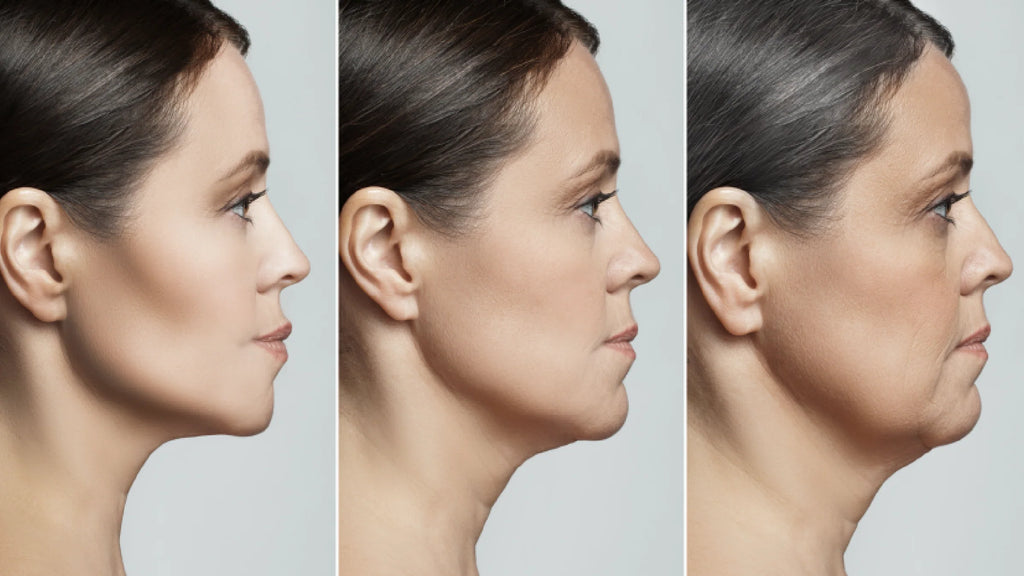
It is the set of changes that appear in the face when a person loses a lot of weight in a short time. The face looks more hollow, more defined and, sometimes, older than one's actual age.
The name is misplaced. Ozempic is a brand; its active ingredient is semaglutide, and it belongs to the GLP-1 receptor agonists, medications that mimic a gut hormone that regulates appetite and blood sugar. The same effect has been described with other drugs in the group, with very restrictive dieting and with weight-loss surgery [4].
The phenomenon is real, but the name attributes it to the wrong cause.
Where did the term come from?
It was coined by dermatologist Paul Jarrod Frank, and the lifestyle press spread it between late 2022 and early 2023 [19][20].
There is one telling detail: the term was born as a press concept, not as a laboratory finding. Serious medical literature starts mentioning it afterwards, citing it [4]. That does not invalidate it, but it does change how much weight it should be given.
Why does the face change when you lose weight?
Facial fat is not decorative filler
Facial fat is organized into compartments: separate pads that support each area [2]. Some give the cheekbone its projection, others fill the temple, others the jawline and the under-eye area.
When you lose weight, those pads empty out, and not all of them equally. The only study that measured this with imaging showed that the superficial ones are affected most and are the ones most closely related to the kilos lost [5]. That is why the face does not just look thinner: it looks “deflated.”
The skin does not contract at the same pace
A review of 40 studies describes that rapid weight loss is associated with thinner skin, with less collagen and elastin [2]. The contents are lost and the container is left over: hence facial skin laxity and deeper folds.
Is it the medication's fault or the weight loss?
What the evidence firmly supports is that the driver of the change is weight loss. The most compelling argument is historical: in 2015, people with massive weight loss from bariatric surgery were perceived as about five years older than their actual age [3].
Does the drug also have its own effect on facial fat? Some laboratory studies suggest so, and a biopsy comparison in ten people found fewer fat stem cells in users of these medications [7]. But that tissue was from the abdomen, not the face. A 2024 commentary called it a “supposed adverse effect” [6].
My reading, with what we have today: weight loss explains almost everything. A direct effect of the drug on the face is possible, but it has not been demonstrated in human facial tissue.
What signs appear in the face?
| Sign | What causes it |
|---|---|
| Hollow cheekbones and midface | The fat pads that project the cheek empty out |
| More visible temples | Atrophy of the temporal fat |
| Sunken eyes and more noticeable dark circles | Loss of support around the eye |
| Deeper nasolabial folds | Collapse of the fat support |
| Double chin and neck laxity | The skin is left with less support |
| Tired appearance | The sum of all of the above |
A very large cohort, with about 297,000 matched patient pairs, found that users of these drugs turned more often to surgery around the eyes [10]. It is an indirect signal, but it is a signal.
How much volume is lost? How many people does it happen to?
How much is lost: there is a number. The imaging study found a loss of about 9% of midface volume, roughly 7% for every 10 kg [5]. It is a single study, with twenty patients, so I treat it as a compass, not as a law.
How many people it happens to: there is no number. There is no published study measuring the frequency [6]. If someone gives you a percentage, they are making it up.
The critique the press rarely mentions
In 2026, a letter in an aesthetic surgery journal pointed out that there are no controlled data demonstrating a facial pattern exclusive to these medications, and that much of the noise may reflect the power of the name more than a new disease [11].
I share that caution. What the evidence best supports is a weight-loss phenomenon with a brand name, not a new condition. That distinction changes how it is approached and with what expectations.
Is Ozempic approved for weight loss?
No. Ozempic is FDA-approved for type 2 diabetes and to reduce cardiovascular and kidney risk in certain patients [18]. The medication approved for weight management with the same active ingredient is Wegovy, at a different dose [21]. Using Ozempic for aesthetic purposes is off-label use, and its management is the responsibility of the treating physician.
What can be done? Treatments and their level of evidence
| Approach | What it addresses | How solid the evidence is |
|---|---|---|
| Hyaluronic acid | Replaces the volume that was lost | The most recommended by expert consensus, extrapolated from facial rejuvenation [9][12] |
| Collagen biostimulators such as Sculptra | Improves skin firmness and quality | First published series, small [13][14] |
| Calcium hydroxylapatite | Volume and stimulation in the lower face | Very preliminary [15] |
| Technologies such as HIFU | Skin firmness | One small controlled trial [16] |
| Autologous fat grafting | Long-lasting volume | No studies in this population yet [17] |
The logic of replacing what was lost is sound and, in practice, it works. But it is presented as a reasonable option, not as a guaranteed result.
How to prevent it from the start
The speed of weight loss is the most decisive factor [9]. Age, hydration and low protein intake also play a role [2]. Losing weight gradually, with nutritional support, protects the face before a single needle is needed.
And there is an ethical tension I do not want to skip: those who prescribe these medications rarely warn about the possible impact on the face [8]. It is not the patient's fault. It is an information gap that ideally would be filled before the first dose.
Frequently asked questions about Ozempic face
What is Ozempic face?
It is the popular name for the facial changes that appear when losing a lot of weight quickly: hollow cheekbones and temples, more pronounced folds and laxity. It is not a medical diagnosis and it is not exclusive to Ozempic.
Is Ozempic face permanent?
Changes due to volume loss tend to persist as long as the weight is maintained, because the lost fat does not come back on its own. They can be addressed with treatment; the exact response depends on each face and requires an assessment.
Does it happen to everyone who uses these medications?
It is not known. No study has measured the frequency. It depends mainly on how much weight is lost and how quickly, as well as each person's age and skin.
Is the medication to blame?
The main driver is rapid weight loss. A direct effect of the drug on the face is possible, but it has not been demonstrated in human facial tissue.
Does hyaluronic acid fix Ozempic face?
It helps replace lost volume and is the most commonly used approach, although specific evidence in this population is still limited. What is right for each case is defined in the assessment.
Can it be prevented?
To a large extent, yes: by losing weight gradually, with good nutrition and hydration, and with early medical care for the face.
Does Ozempic work for weight loss?
It is not approved for that; its indication is diabetes and cardiovascular and kidney protection. The one approved for weight management is Wegovy. Its management is the responsibility of the treating physician.
In summary
“Ozempic face” is a real phenomenon with the wrong name: rapid weight loss empties the fat pads that support the face, over skin that cannot adapt in time. It can be prevented and managed.
If you are losing weight or about to start, and you want to understand what to expect for your face, message us EVALUATE on WhatsApp and we will schedule your assessment.
About the author
Dr. Olga Gómez Montoya, physician and surgeon from the University of Antioquia, practicing natural aesthetic medicine in El Poblado, Medellín.
Educational information. It does not replace a medical assessment. Management of the medication is the responsibility of the treating physician.
References
- FDA and EMA: Ozempic prescribing information without “Ozempic face” listed as an adverse reaction. FDA 2025 · EMA
- Barone M, et al. Systematic review (40 studies) on skin and rapid weight loss. Aesthetic Plast Surg. 2026. PubMed
- Couto RA, et al. Massive weight loss and perceived facial aging. Aesthetic Plast Surg. 2015. PubMed
- Catalfamo L, et al. J Clin Med. 2025. PMC
- Sharma RK, et al. Facial volumetric quantification (n=20). Otolaryngol Head Neck Surg. 2025. PubMed
- Carboni A, et al. J Drugs Dermatol. 2024. PubMed
- Firsowicz M, et al. Dermatol Surg. 2026. PubMed
- Humphrey CD, Lawrence AC. Facial Plast Surg. 2023. PubMed
- Nikolis A, et al. International Delphi consensus. J Cosmet Dermatol. 2025. PubMed
- Lishinsky-Fischer N, et al. TriNetX cohort. Plast Reconstr Surg. 2026. PubMed
- Sharp G. Critical letter. Aesthet Surg J Open Forum. 2026. Oxford Academic
- Fabi S, et al. Dermatol Surg. 2026. PubMed
- Lorenc ZP, et al. Aesthet Surg J. 2026. PubMed
- Avelar LET, et al. Clin Cosmet Investig Dermatol. 2026. PubMed
- Durairaj KK, et al. Aesthet Surg J Open Forum. 2025. PubMed
- Moradi A, et al. Dermatol Ther (Heidelb). 2026. PubMed
- Chalhoub X, Yang Ng Z. Aesthet Surg J. 2026. PubMed
- FDA. Ozempic (semaglutide) prescribing information, 2025. PDF
- Synnott A. The New York Times, Jan 24, 2023. Link
- Rosen J. Town & Country, Nov 29, 2022. Link
- EMA. Wegovy product information. PDF
Artículos relacionados
10
Oct
07
Oct

07
Oct

07
Oct
07
Oct

![SVR Ampoule B [B3] Hydra 30 ml, sérum hidratante con niacinamida y ácido hialurónico](http://www.olgagomez.com.co/cdn/shop/files/Ampoule__B__2000x2000_14d5c39f-f664-464a-a86d-22e925085cfc.jpg?v=1791397813)
![SVR Ampoule B [B3] Hydra 30 ml, sérum hidratante con niacinamida y ácido hialurónico](http://www.olgagomez.com.co/cdn/shop/files/SVR_retouche_ABC_Ampoule_B_02_1200x1200_f9dbbec9-d113-461f-b0eb-8040cb9df6e5.jpg?v=1791397813)


